Why Your First Draft Isn’t Ready for the Printer Yet?
Let’s be honest. Typing that final period on your manuscript is a high like no other. You’ve spent months or years staring at a blinking cursor, running on caffeine, and pouring your actual soul onto the page. The urge to immediately email it to a publisher or hit upload on Amazon KDP is almost painful. The frequent thoughts of “is it good enough” make you second-guess yourself every time.
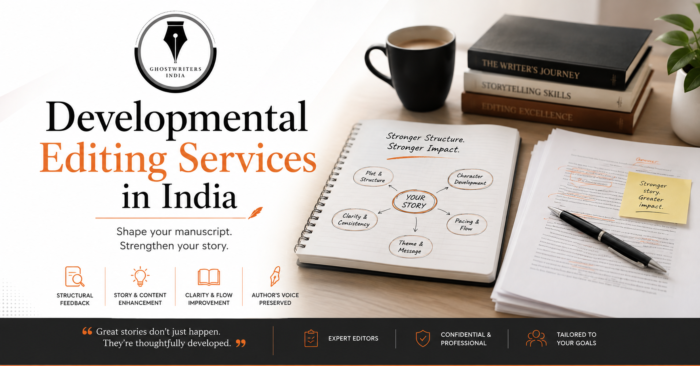
But here is something every writer needs to hear and most writers do not know: your first draft is your raw thoughts, and they are organized according to you. But they may not necessarily make sense to someone else who reads it (your readers). A common assumption and understanding among writers and authors is that editing just means fixing typos and polishing commas. We think a quick proofread is the final step. But the truth is, if your plot falls apart in chapter four, a perfectly placed semicolon won’t matter. Developmental editing services in India isn’t about your grammar; it’s about someone ripping the engine out of your book to see if it actually runs. The power of the right kind of editing is such that it can make all the difference for your career as an author and for the future of your book.
Also Read: Top Book Marketing Agencies in India in 2026
What is Developmental Editing (And How Fiction Differs from Non-Fiction)?
Developmental editing is a concept that has gained familiarity only in recent years. It’s a bird’s-eye view of your pacing, structure, and whether the core promise of your book actually keeps a reader turning pages. But how an editor approaches your pages changes completely depending on what you’ve written.
If you are writing a novel, your editor is basically playing the role of psychologist to your characters and architect to your plot. They will look at your manuscript and ask the uncomfortable questions. Why did your protagonist suddenly change their mind? Why does the dialogue sound like a stiff corporate email instead of two friends talking? Why does the pacing drag so badly in the middle? They are trying to make sure your readers actually feel something.
But if you are writing non-fiction, maybe a business guide, a self-help book, or a research text, the editor doesn’t care about character arcs. They care about your logic. They check your information hierarchy to see if your arguments actually hold up or if you’ve just written a massive lecture. They ensure your chapters flow naturally so the reader not only learns and enjoys what you have shared, but also looks forward to reading more from you and recommends you to their circle.
You can select Ghostwriter for your book with best ghostwriters in India. But if you have written the book by yourself and you are not so comfortable with it, you will need a developmental editor.
Also Read: Manuscript Editing Services
The Indian Advantage: Navigating Cultural Nuance, Market Dynamics, and Localization
Due to experience, professionalism and other factors like English being the first language, hiring an editor from the US or UK may seem like a wiser decision. But before making that decision, consider the factors that those editors are not familiar with the Indian way of life, prevalent customs and their significance, the local slang or trends and such details, which only a native would be familiar with. Most importantly, the editor might not even be able to understand or relate to what you are saying. A local editor knows the difference between a character sounding genuinely authentic and sounding like a caricature. Plus, they actually know the Indian publishing landscape. They know what acquisitions teams at traditional houses like Penguin India or HarperCollins India are looking for right now, and they know what clicks on local self-publishing platforms like Astitva Prakashan.
Also Read: End-to-End Ghostwriting and Publishing Services for Authors
When is the Right Time to Hire a Developmental Editor?
Timing is everything, and handing over your manuscript the second it’s finished is a massive mistake. Instead, close the laptop, step away, and let the manuscript sit in a drawer for a couple of weeks. You need distance from your own words. When you finally open it back up, you’ll see the pages with fresh eyes and immediately catch the obvious plot holes, the places where you were just rambling to hit a word count, and the scenes that simply don’t work. An editor’s job isn’t to clean up a messy brain dump; they need to receive the absolute best version of the book you can possibly build on your own. And once you finally do send it over, brace yourself to wait. A real, deep-dive structural edit takes anywhere from four to six weeks because the editor is effectively taking your book apart and putting it back together. You simply can’t rush that kind of work.
The Step-by-Step Developmental Editing Process
Handing your book over to a stranger can feel incredibly scary and vulnerable. To ease that anxiety, it helps to know exactly what you’re going to get back. The process usually delivers two things.
First, you’ll get an Editorial Letter. This is a massive, deep-dive report, often five to fifteen pages long, that looks at the macro health of your book. It acts like a supportive but brutally honest roadmap, telling you what is working beautifully, what needs a total overhaul, and offering actual strategies to fix the broken parts.
Second, you will see Inline Notes. These are the comments left right in the margins of your Word document. They point out the exact moments where a scene drags, a character acts completely out of alignment, or a transition feels jarring. Expect to feel an emotional wave when you open these files. It hurts to see your hard work covered in critiques, but this is the fire that refines a raw draft into a real book.
What a Developmental Editor Will Not Do For You?
To save yourself from frustration, you need to know where an editor’s job ends and yours begins.
First and foremost, they are your partner, not your ghostwriter. A developmental editor will diagnose the problems and suggest ways to fix them, but the heavy lifting of actually rewriting the scenes and reshaping the dialogue is entirely on you. They also aren’t looking at typos right now. Because entire chapters might be cut or rewritten during this phase, it’s a waste of time to polish commas. That happens later. Finally, remember that a great editor elevates your book, but they cannot guarantee a traditional book deal or instant stardom.
Also Read: Ghostwriting + Editing + Publishing: A Complete Workflow Guide for Authors
How Much Does Developmental Editing Cost in India?
Let’s talk about the elephant in the room: the cost. Because developmental editing requires immense strategic thinking, time, and creative energy, it is the most expensive tier of editing out there.
In the Indian market, you’ll usually see per-word pricing, which typically ranges from ₹1.50 to ₹4.00 or more per word. If you’ve written a thick book, that number stings. It’s tempting to think you could use that money for a vacation instead.
But publishing a structurally broken book is a permanent mistake. Confusing plots and flat characters lead to bad reviews, and those stay on Amazon forever. The beauty of the Indian market right now is that you can find incredible editors who worked at major traditional publishing houses offering world-class structural critiques at competitive domestic rates. It’s a genuine investment in your career.
How to Vet and Choose the Right Editor in India?
Finding the right editor is a lot like dating, you need high-level expertise, but you also need to actually click with the person.
Your first step is checking for genre alignment. A brilliant romance editor is going to struggle with a corporate memoir or a high-fantasy epic. Find someone who genuinely loves and understands your specific niche. Once you find a potential match, always ask for a paid sample edit of about 1,000 words. When they send it back, don’t just look at what they changed. Look at how they said it. Do their suggestions make you feel inspired to rewrite, or do they make you want to burn your laptop? You want an editor who is tough but fiercely on your team.
Skip generic freelance platforms where people race to the lowest price. Look for professionals on LinkedIn, dedicated editing agencies, or networks within the Indian writing community.
Using Developmental Editing for Yourself
It is incredibly hard to hand over something you’ve spent months or years working on alone. It feels completely exposing, and it’s totally normal to feel defensive before anyone even reads a page. But a good editor isn’t there to judge you or rewrite your story in their own voice. They are just the fresh set of eyes you need when you’ve stared at the same chapters for so long that you can’t see the forest for the trees. They are there to help you spot the confusing parts and the pacing drops so your original vision actually makes sense to a reader.
Spending the time and money on this kind of big-picture editing is a heavy lift, but it’s the one thing that saves you from the heartbreak of putting a book out there that doesn’t hit the way you wanted it to. It’s what transforms a messy, passionate draft into a real book that stays with people after they close the cover.
Also Read: 20 Best Self Publishing Houses in India